Under the Table: One Illustrator's Mission to Draw Every Wetherspoon Carpet in Britain
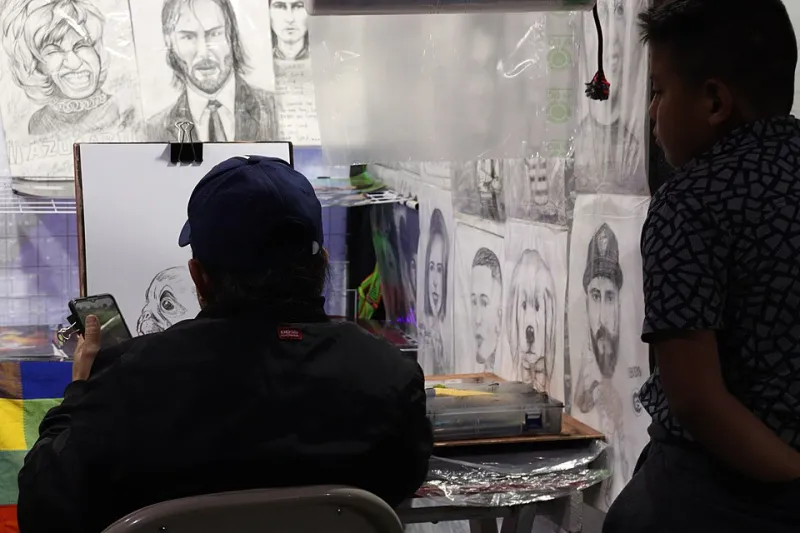
Photo: Ehécatl Cabrera, CC BY-SA 4.0, via Wikimedia Commons
It's half two on a Thursday and Nell Harrop is on her hands and knees in a Wetherspoon in Sheffield, which is not as dramatic as it sounds. She's got a hardback sketchbook open on the floor, a pencil behind her ear, and a pint of lime and soda going flat on the table above her head. Nobody in the pub is paying the slightest bit of attention. A bloke in a fleece has just stepped over her to get to the gents.
“That's the whole appeal, honestly,” she says, once she's back upright. “You can be completely invisible in a Wetherspoon. It's one of the last rooms in Britain where nobody expects you to be doing anything interesting.”
Harrop, 31, is an illustrator and printmaker based in Sheffield. Since the spring of 2023 she's been drawing the carpets of Wetherspoon pubs — not the buildings, not the punters, just the carpet — and posting each one to an Instagram account that has quietly picked up a following far bigger than she expected.
How the project started
The origin story is not glamorous. Harrop was on a train back from a wedding, hungry, skint, and two hours from home. She ended up in a branch of the chain near the station with a cheap burger and a notebook, and found herself staring at the floor.
“I'd seen the memes, obviously. Everyone's seen the memes. But I'd never actually looked at one of the patterns properly,” she says. “This one had hops and a sort of wheat sheaf thing going on, and a border that was trying to look like a picture rail. Someone had thought about it. Somebody had sat in an office and made decisions.”
She drew it badly, in biro, in about eleven minutes. Then she drew another one the following week. Three years later she's filled nine sketchbooks and documented more than 260 pubs across England, Scotland and Wales — a number she's slightly embarrassed by, as though it's a confession.
The quiet genius of British contract carpet
The carpets are almost always made from the same family of materials: heavy-duty nylon or wool-blend contract carpet, woven in broadloom, cut to fit a room. The patterns are designed to do two jobs at once — hide stains and give a vast, high-ceilinged space some sense of itself.
“It's genuinely clever design and almost nobody gives it credit,” Harrop says. “A carpet in a pub like that has to survive a Friday night, a Sunday carvery and a decade of hot drinks. And it still has to look like somewhere, not just some grey void. That's a real brief.”
She's developed a rough taxonomy over the years. There are the heritage ones — local landmarks, bridges, cathedrals, a shipping forecast of regional references. There are the botanical ones, all vines and leaves, which she says are the most common and the hardest to draw without going slightly mad. And then there are the odd ones: the ones with a phoenix, or a maze, or what appears to be an abstract tribute to a roundabout.
“My favourite so far is a carpet in the north east that's basically an optical illusion. It looks flat from the door and then it sort of tilts when you walk across it. I sat there for an hour and a half trying to work out how they'd done it. The staff must have thought I was unwell.”
Pencil, watercolour, and a lot of waiting
Her process is deliberately slow. She asks staff if it's alright first — always — and she never photographs the pattern as a shortcut. Instead she draws it on site, usually in pencil, then works it up at home in watercolour and coloured pencil. A single carpet takes between three and six hours.
“If I photographed it, it would be an archive. Drawing it makes it a drawing,” she says. “You notice different things when you're copying by hand. You notice where the designer got lazy. You notice the repeat. You notice that the border doesn't quite meet in the corner, which is because the fitter had a bad day.”
She sells risograph prints of a handful of the patterns, and a small zine, and has never once been asked to stop. She's careful not to include logos, pub names or anything that feels like free marketing — a distinction she's had to defend more than once.
“Someone said to me, isn't this just unpaid advertising for a massive chain? And it's a fair question,” she says. “I'd say there's a difference between celebrating a company and paying attention to a thing a company made. If I draw a bus shelter, I'm not endorsing the council.”
Why ordinary rooms are worth looking at
What the project has really become, three years in, is an accidental record of a very specific kind of British interior — one that's disappearing, changing or being refurbished into something paler. Several of the pubs she's drawn have since had their carpets ripped out. Two have closed entirely.
“There's a carpet in Doncaster I drew in 2024 that isn't there any more,” she says. “I didn't know it at the time. I just thought I was making a nice picture.”
That's the bit that lands hardest. The carpets, much-memed and endlessly joked about, turn out to be one of the last places in the country where somebody bothered to put a pattern on the floor of a room where working-class people eat their tea. Harrop is careful not to make it sound grander than it is. She's a person with a sketchbook, not a cultural historian.
“I don't want to over-egg it,” she says. “It's a carpet. But it's also a room people remember. I've had so many messages from people saying 'that's the one from my nan's local' or 'I had my first pint in there.' That's the whole reason I keep going.”
What's next
There's a book in the offing, though she won't say who with yet, and an exhibition planned for a library in Sheffield rather than a gallery. She's aiming to reach 300 pubs before she stops, a target that will take her to the Highlands and to a couple of branches on retail parks in the Midlands that she describes, with great affection, as “the worst ones.”
As for the Sheffield carpet, she finishes it at the table with the lime and soda now warm and a scattering of pencil shavings on her knee. It's a burgundy and gold thing with an interlocking knot, the sort of pattern you'd walk over a thousand times without seeing once.
“That's the point, though, isn't it,” she says, packing up. “You can look at the same floor for twenty years and never really look at it. It's not the carpet that changes. It's whether you've decided to notice.”