The Last Hot Handover: Ten Friday Nights in the Chip Shop Queue
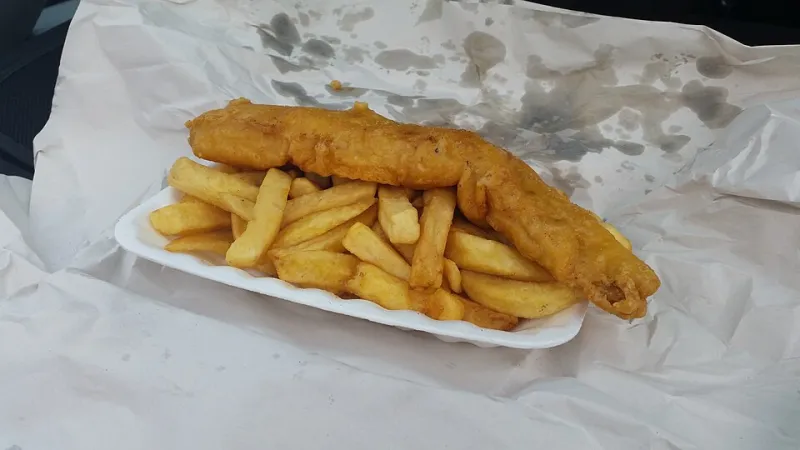
Photo: Gvjekoslav, CC0, via Wikimedia Commons
There is a particular kind of British patience that only exists outside a chip shop on a Friday. It smells of hot vinegar and old newspapers, and it sounds like someone saying, “Go on then, I’ll have a small one,” as if they have not ordered the same thing every week since 2019.
I spent ten Friday nights this autumn in ten different chip shop queues — a bright, busy stretch in north London, a quiet parade of shops near the coast in East Sussex, a village chippy with a hand-written sign about card payments, and a few stops in between. I was not there to review the food, though I ate plenty of it. I was there to listen to the nine or ten minutes before the paper bag is handed over, because that is where the real business of the evening seems to happen.
The Regular Who Never Says the Order
At the first shop, in London, the man in front of me did not speak his order. He nodded at the woman behind the counter and she said, “Usual, love?” He nodded again. Two fish, one chips, a pickled onion, and a can of something from the fridge that he fetched himself. She wrote it on the pad without looking up.
It turned out he had been coming in every Friday for eleven years. He had seen her through a change of owner, a new fryer, and the great vinegar-cork shortage of 2022, which he mentioned as if it were a war he had served in.
“She knows what I want before I do,” he told me, slightly proud. “That’s not service, that’s friendship.”
Behind him, a younger couple were having a very earnest conversation about whether to get a battered sausage to share. They were still deciding when the man’s order arrived. They looked at his bag as if it contained the answer.
Salt, Vinegar, and the Weather
The seaside shop was quieter. It was a Friday in late October, and the town had that out-of-season feeling — the arcade lights on, but only three people inside. The queue was five deep, mostly dog walkers and one man in a fleece who seemed to know everyone.
While we waited, the woman in front of me told the man behind her that the wind had changed. He said it would be rain by Sunday. She said her knees agreed. Then the woman at the fryer said, “You two are not still on about the weather?” and everyone laughed, including me.
It is easy to be sniffy about small talk. But in a chip shop queue, small talk is the whole point. It is the lubricant between strangers who are about to eat hot food out of paper with wooden forks. You cannot stand that close to someone’s dinner and not acknowledge them.
The Friday Night Economics of Fish
In every shop, someone mentioned the price. In 2026, a large cod and chips is not the cheap Friday treat it once was, and people say so with a kind of resigned cheerfulness. At the London shop, a man in a builder’s jacket told the queue that he remembered when a portion was £3.50. The woman behind the counter said, “So do I, love, and I was the one selling it.”
The interesting thing was not the grumbling. It was the way people adjusted. A family of four shared two large portions and added a bag of chips. A teenager ordered a sausage and chips and made it last. An older couple split a fish and bought a single tea to share. Nobody made a scene. They just did the small arithmetic of a Friday night and got on with it.
The woman at the fryer in the village shop told me she had stopped putting up the menu board in large writing because it was “too bloody depressing”. Now she just tells people the price and waits. “They still order,” she said. “They just order less. Or they order the same and moan for a bit. Both are fine.”
The Names on the Wall
At the shop near the coast, there was a corkboard by the door with photographs of dogs, a missing cat poster, and a receipt from 2023 with “BEST CHIPS IN TOWN” written on it in biro. The staff knew the dogs’ names before the owners’. A man came in with a spaniel and the woman behind the counter said, “Hello, Buster, you having your usual?” The dog did not answer, but the man did.
This is the quiet value of a chip shop. It is not a pub, so you do not have to stay. It is not a café, so you do not have to sit down. It is a small, bright room where you wait, and in that waiting you become briefly known. Not in a big way. Just enough. Your order, your dog, your Friday face.
The Stranger Who Pays It Forward
On the eighth Friday, I saw a man pay for the next person’s chips. He did not make a thing of it. He just put a tenner on the counter and said, “That’ll cover hers too,” nodding at the woman behind him, who was counting coins. She looked startled, then pleased, then slightly embarrassed. He said, “Don’t worry about it, love, it’s Friday,” and left with his bag.
The woman behind the counter shrugged at me. “Happens more than you’d think,” she said. “Not every week. But enough.”
I have thought about that tenner a lot. It was not charity in any grand sense. It was just a small, salty kindness, handed over with the vinegar and the paper. The sort of thing that does not get recorded anywhere. The sort of thing that makes a Friday feel like a Friday.
What the Queue Knows
By the tenth Friday, I had stopped taking notes in the queue, because it felt rude. I just stood there, listened to the fryer, and watched the little world of the shop do its thing. The regulars. The staff. The people who had clearly come out because they did not want to cook. The people who had come out because they did not want to be alone.
The chip shop queue is not a social club. It is not a community centre. It is a few square feet of lino and warm air and the smell of salt, and it lasts maybe ten minutes. But in those ten minutes, Britain does a quiet version of itself: patient, nosy, generous, and mildly obsessed with the weather.
And then the bag is handed over, hot and heavy and wrapped in yesterday’s news, and everyone goes home.