The Borrowed Room: Sitting With Ten Strangers and the Names on Their Benches
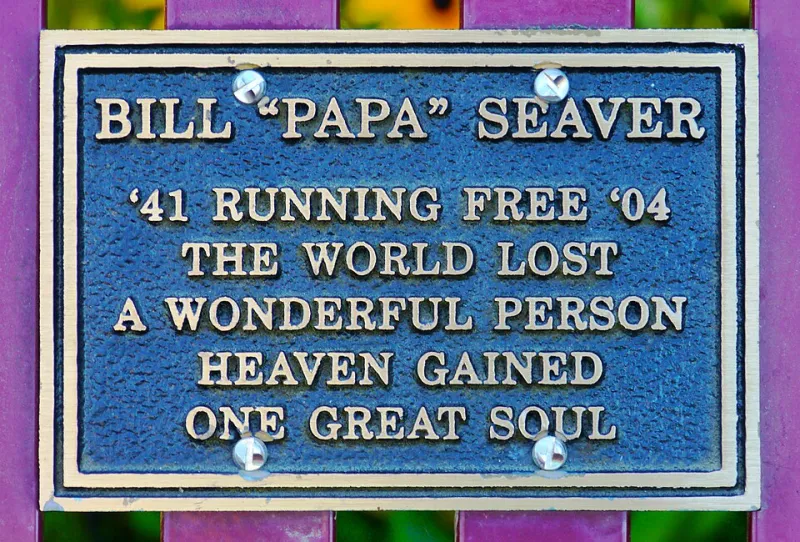
Photo: Rick Obst, CC BY 2.0, via Wikimedia Commons
The bench was nothing special. Green slats, iron arms, a view of a bin and a slightly tired flowerbed. Then I read the plaque: For Doreen, who loved a good sit and a bad pun. I sat down because my feet hurt. I stayed because a man in a raincoat arrived, nodded at the plaque and said, 'Morning, Doreen,' before opening his sandwich.
That was the beginning of a small obsession. Over the next week I visited parks in London, Sheffield, Glasgow, Norwich, Bristol, Leeds, Cardiff, Newcastle, Margate and Aberystwyth. I was not researching grief in the grand sense. I was just sitting down, reading brass, and asking people why they had chosen that particular seat. Ten strangers later, I had a notebook full of answers and a new respect for a very British kind of public tenderness.
The bench as a borrowed room
A memorial bench is not a shrine. It has a job to do. It holds bags, tired legs, half a sandwich, a phone call to a daughter. It is a piece of street furniture with a name on it, and that is exactly what makes it work. The dedication is private, but the seat is not. Anyone can use it. Anyone can bring their own life to it for twenty minutes.
I met a woman in Sheffield who called this 'borrowing the room'. Her father's plaque read: For Arthur, who walked here every day and complained about the weather. She told me she comes on Sundays with a flask, not to cry, but to sit where he sat. 'You can't own a bench,' she said. 'That's the point. He liked the company. Even the company he didn't know.'
Ten seats, ten small doorways
In Finsbury Park, Marcus ate his lunch beside a plaque to a woman he had never met. He said he chose the bench because it was in the sun. The plaque was a bonus. 'I say hello to her,' he said. 'It feels rude not to.'
In Glasgow, a taxi driver named Callum sat on a bench dedicated to his friend Ewan. The plaque read: Sit down. You look like you need it. Callum laughed when he told me that Ewan had written the line himself, years before, as a joke. 'He'd be raging he didn't get to see it,' he said. Then he shifted along so an elderly woman could put her shopping down.
In Aberystwyth, a student called Lowri revised for an exam on a bench overlooking the sea. The plaque was for Gwen, who watched the water. Lowri had no connection to Gwen, but she liked the idea of a seat with a purpose. 'It makes revision feel less lonely,' she said. 'Like someone else is keeping an eye on the horizon.'
In Norwich, I found a plaque for Margaret, 1934 to 2019, always early. A man named Jo was eating chips on the next bench along. He told me Margaret had been his neighbour. 'She was early for everything,' he said. 'Funerals. Weddings. The bin men.' He gestured at the plaque with a chip. 'This is the only time she's been late.'
In Newcastle, a retired teacher called Stan sat with a bag of birdseed. The plaque was for a different Stan, but he liked the coincidence. For Stan, who fed the pigeons and complained about the pigeons. He said he had never met the man, but he felt a kinship. 'I feed them,' he said. 'I complain about them. It's a tradition.'
In Bristol, a young woman named Priya sat on a bench dedicated to someone's dad and his terrible jokes. The plaque said: For our dad, who told terrible jokes here. Priya was waiting for a friend. She said the plaque made her miss her own dad, who was alive and well in Birmingham. 'I texted him,' she said. 'Just to say his jokes are still terrible.'
In Leeds, a runner stretched his calves against a bench dedicated to Sam, who never sat still. He told me he used the bench every Tuesday. He had never met Sam. He liked the irony. 'I'm not sitting still either,' he said. 'I'm just passing through. It feels right.'
In Cardiff, a young man named Rhys sat on a bench dedicated to Nye, who knew every dog's name. Rhys had a dog called Biscuit. He said he chose the bench because it was near the gate and Biscuit liked to greet everyone. 'Nye would have known Biscuit,' he said. 'I think he'd have liked him.'
In Margate, a dog walker called Elsie sat on a bench for Elsie, who preferred the off-season. She said it was the first time she had ever seen her name on a plaque. 'I don't know who she was,' she said. 'But I agree with her. August is too much.'
The etiquette of sitting with a stranger's name
There is an unspoken rule to memorial benches. You can sit. You can eat. You can take your shoes off if the park is empty. But you do not put your bag on the plaque. You do not let your dog wee on the leg. You do not ask too many questions of the person who is clearly there for a reason.
One woman in Margate told me she had once asked a man if he knew the person on the plaque. He said no, he just liked the view. She felt foolish. Then he said, 'But I say good morning to her anyway.' That, I think, is the etiquette: let the plaque be a name, not a test.
What the brass cannot hold
Most plaques are short. A name, two dates, a line or two. They cannot hold a whole life. They cannot explain the argument at Christmas, the hospital appointments, the favourite biscuit, the way someone laughed with their whole body. They are not meant to. They are a handle on the door of a memory, and the door is always slightly open.
In Newcastle, Stan told me that he liked the plaques because they were proof that people had been there before him. 'You walk through a park and think it's just grass,' he said. 'Then you look closer and it's full of people.' He was right. Once I started reading the plaques, I could not stop seeing them. Every bench had a name. Every name had a seat. Every seat had someone who might sit down next.
The last light
On my last afternoon, I went back to the first bench. Doreen's bench. The man in the raincoat was not there. A teenager was sitting with her feet up, scrolling her phone. She had no idea who Doreen was. She did not need to. The plaque caught the last of the light, and the bench did its job. It held her.
That is the quiet life of a British park seat. It is not a monument. It is a place to rest. The brass just reminds us that someone else rested here first, and that the park is a little less empty because of it.