The Last Small Thing: Eight Makers on the Closing Rituals That Draw a Line Under the Day
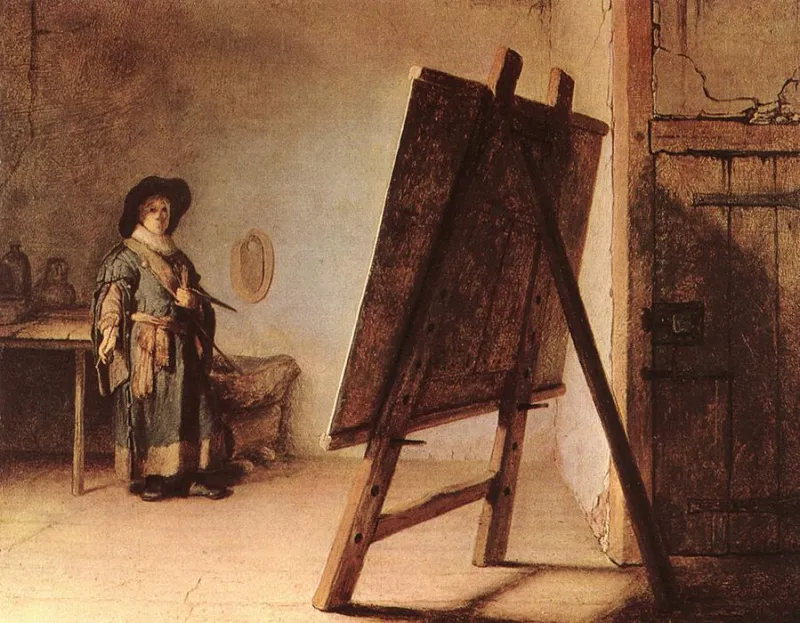
Photo: Rembrandt, Public domain, via Wikimedia Commons
It is 5.40pm in a spare room in Leeds and Priya is sharpening pencils. Not because she needs them. The illustrations are finished, the client email has been sent, and the kettle has already gone quiet. She sharpens four pencils anyway, lines them up beside the window, and only then switches off the lamp. “If I don’t,” she says, “I’ll be back in there at nine o’clock, moving a图层 around and telling myself it’s work.”
That small, repeated action is what this piece is about. Not the big creative routines, not the morning pages or the studio rituals that look good in a magazine shoot. The last five minutes. The fiddle. The closing ceremony that tells a home studio, a kitchen table or a converted shed that the working day has actually ended.
In autumn 2026, with more people than ever making things from spare rooms and garden buildings, those tiny boundaries matter. So I rang eight UK makers — illustrators, ceramicists, sewists, printmakers and one very organised bookbinder — and asked a simple question: what do you do before you stop?
The signal, not the tidy-up
Almost everyone was keen to point out that their ritual is not really about tidiness. A tidy studio is a nice side effect. The point is the signal.
“It’s a handbrake,” says Callum, a ceramicist in Glasgow. “You don’t put the handbrake on because the car is dirty. You put it on because you’re leaving.”
Callum’s handbrake is a damp sponge. He wipes the wheel head, covers the clay with a cut-up shower curtain, and sprays the same sad-looking fern on the windowsill. The fern has nothing to do with pottery. It is simply the last thing he does. “If I skip the fern,” he says, “I lie awake thinking about a rim I didn’t finish. It’s ridiculous. But the fern works.”
The wheel, the cloth, the same three songs
Mireille, a sewist in Bristol, has a routine that takes precisely three songs on Radio 6 Music. She lifts the presser foot, winds the bobbin, brushes the lint from around the needle plate, and drapes a tea towel over the machine. The tea towel is from Whitby and has a picture of a lighthouse on it.
“I used to think I needed to leave everything out so I could ‘pick up where I left off’,” she says. “But I never did. I’d come down in the morning, see the mess, and feel guilty before I’d even had a cup of tea. Now I cover the machine and the room feels neutral. It’s like putting a bookmark in.”
Tom, a printmaker in Norwich, has a more industrial version. He scrapes the ink slab, counts the rags into a pile, and locks the drawer where the good lino cuts live. The counting is the bit that matters. “Four rags,” he says. “Every time. If I’ve got five, I know I’ve left something out. It’s not a system. It’s a superstition with useful side effects.”
“It’s how the room tells me it’s over”
For Aisha, a jeweller in Birmingham’s Jewellery Quarter, the ritual is sound rather than sight. She sweeps the bench with a small brush, tips the dust into a jar, and then pulls the blind down halfway. The blind makes a particular clack. “That’s it,” she says. “That’s the noise. If I don’t hear the clack, I’m still at work.”
Rhys, a woodworker in Cardiff, does something similar with smell. He blows the sawdust off the bench, wipes his hands on his apron, and rubs a little beeswax into the same offcut of oak. The offcut lives by the door. “It’s a daft thing,” he admits. “But the smell of the wax means down tools. My wife says she can tell what kind of day I’ve had by whether I’ve done the wax.”
Eilidh, a textile artist in Dundee, has a five-minute fiddle that is almost aggressively practical: she sets out the next morning’s first task. Not a list. One thing. “I put the right thread on the table, or I lay out the fabric I need to cut,” she says. “Then I close the door. It means tomorrow starts with a decision already made.”
The ones who skip it
Every maker I spoke to had a story about skipping the ritual. The results were remarkably similar: a vague sense of unease, a late-night check of the studio, or a morning that began in a fog of low-level guilt.
Sam, a bookbinder in Brighton, forgot his closing routine for a week during a busy spell last summer. “I just left everything mid-glue,” he says. “By Friday the room felt like a complaint. I couldn’t work in there until I’d spent an hour resetting it. The five minutes I thought I was saving cost me an hour.”
Priya puts it more bluntly. “If I don’t sharpen the pencils, I don’t stop. It’s not about the pencils. It’s about the fact that I’ve decided to stop. The pencils are just the excuse.”
A five-minute rule that actually works
None of these rituals are complicated. That seems to be the point. A ritual that takes twenty minutes is a chore. A ritual that takes five is a hinge.
The makers I spoke to offered a few practical threads. Keep it small enough to do on a bad day. Attach it to something physical — a cloth, a switch, a sound. Do the same thing in the same order. And don’t confuse it with a full tidy-up, which is a different job and often a way of avoiding the actual stopping.
“The studio is never finished,” says Callum. “That’s the trick. You have to decide when you’re finished, not when the work is. The work will always have another edge.”
What to try tonight
If you work from home, the last five minutes can blur into the next five hours. A closing ritual does not have to be beautiful. It can be a wiped table, a covered machine, a sharpened pencil, a single note for tomorrow. It can be the same three songs, the same jar of dust, the same clack of a blind.
The makers in this piece are not productivity gurus. They are people with clay under their fingernails and invoices on the mantelpiece. But they have all found a small, repeatable way to say: that’s enough for today. The room is closed. The kettle is off. The pencils are sharp.
Tomorrow, they will start again.